
Bill Lin — A Journey Shaped by Go, Choices, and Time
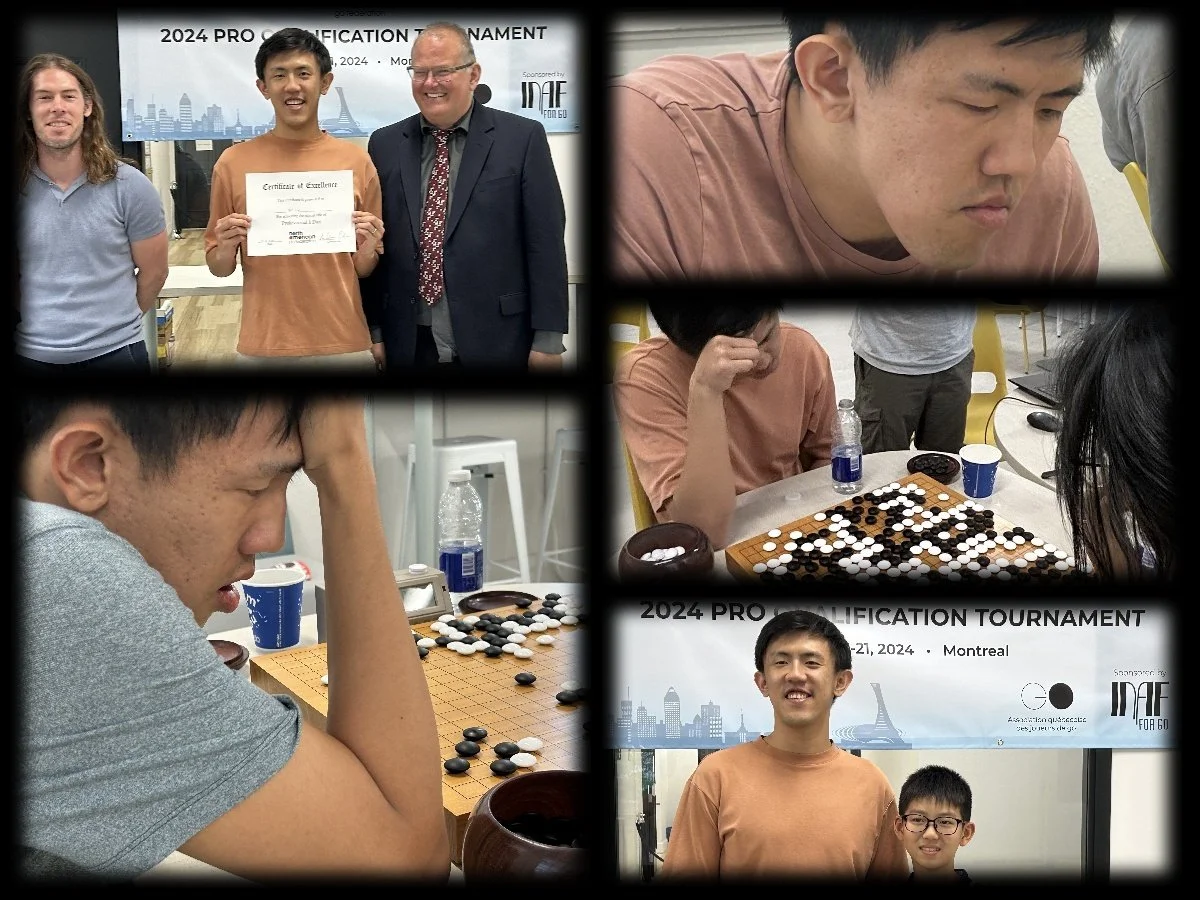
When Bill Lin entered the 2024 NAGF Professional Qualification Tournament, he believed he had a reasonable chance of reaching the semifinals, but few expected the dominating performance that followed. Over the course of the event, he put together an impressive 9–1 record and finished with a decisive 2–0 sweep of Sen Zhan in the finals, earning his professional Go certificate and becoming North America’s newest pro. Reflecting on the moment, Lin said that the key difference between this attempt and his previous one lay not in raw skill, but in mindset. A decade earlier, at just seventeen years old, he had participated in the second professional qualifier with fierce desire but also overwhelming pressure. He recalls that he “wanted it more,” yet found himself weighed down by stress and expectation. This time, however, his approach was different—calmer, steadier, focused only on playing one game at a time. Life experience, he now believes, makes an enormous difference.
That experience includes stepping away from Go entirely during the pandemic, a period in which he dedicated himself to work as a financial trader. Even while away from the board, Go continued to shape his thinking. Trading, like Go, demanded a deep understanding of probability, win rates, risk-reward balance, and decision-making under uncertainty. In addition to professional maturity, Lin entered a new chapter personally, becoming engaged and finding himself in a stable and grounded stage of life. These changes helped him return to competition with clarity and composure. In preparation for the ProQual, he spent several months training with AI tools, focusing particularly on the middle and endgame—the phases where games are won, reclaimed, or lost. AI sharpened his ability to evaluate unsettled positions, calculate the value of moves, judge who was ahead, and make decisions based on win-rate analysis rather than emotion. Anyone who watched him play that week could recognize the results.
Although he had just completed an intense week of high-level matches, Lin appeared energized afterward, speaking with enthusiasm about attending more tournaments and avoiding early exits. More importantly, he expressed a strong desire to contribute to the broader Go community, helping raise competitive standards, expand the player base, and increase the game’s visibility in North America. To him, this is the true responsibility of a professional—expanding the influence of Go beyond personal accolades.
Long before earning his professional status, Bill Lin—known in Chinese as Lin Tianyu—had already built a remarkable Go story. Born in Ningbo, he began learning the game at five or six years old, influenced by his father. Energetic and athletic, he appeared older than other children his age. At ten, he immigrated to Canada with his family, holding a modest amateur 3-dan ranking at the time. With no Go schools in Canada, Lin spent six years improving through self-study, books, and online play. His strength grew rapidly, and during the North American selection for the World Mind Sports Games, he famously defeated Feng Yun, a 9-dan professional, demonstrating his potential. At the Games themselves, he faced a difficult draw, losing to Jiang Weijie in the first round and to Lin Junyan in the second—who later defeated Tuo Jiaxi. Yet Lin remained realistic and cheerful, acknowledging the large gap between himself and established professionals while genuinely enjoying the opportunity to play against them.
Despite the growing momentum, Lin chose not to pursue a professional career at sixteen, even though North America had just launched its official professional system and he had a strong chance of qualifying. His reasoning was simple: he believed that becoming a professional could create pressure that would take away the joy of the game. Go had become a passion and a comfort, but he did not want it to become an obligation. He described himself as someone who would feel uneasy if he could not touch Go at all, yet equally uncomfortable if required to play constantly. This delicate balance helped shape his view of Go not as a career path, but as a lifelong companion.
During one winter break, Lin spent two weeks training at a Go dojo in Beijing. The experience was intense—ten hours of Go study per day, limited rest, unsuitable meals, and physical exhaustion, especially for someone who swam frequently and required greater nutritional intake. He admitted he could not withstand such rigorous conditions and reflected on the experience with humor, suggesting that perhaps his previously comfortable lifestyle made it difficult to adapt. He was also aware of the story of Tang Ke, an American Go prodigy who trained for two years in China and eventually lost interest in the game. Lin recognized how easily such pressure could erode passion.
Lin also observed the broader landscape of Go in North America. While Go had begun to professionalize and participation was increasing, he believed true competitive emergence would take at least one more generation. He suggested that only when his children reach his current age might North American Go stand on equal footing with Asia. The reasons were practical: players could not rely on prize money for income, the skill gap continued to widen, and most strong players in North America were still ethnically Chinese. He admired Europe’s Go environment, where many top players were non-Asian and participation was widespread. In Canada, Go was far less common, and unlike the United States—which had Feng Yun’s Go school and the Ing Foundation—Canada lacked institutional support. Swimming, rather than Go, became his social bridge, and he trained eight times a week, reaching a level comparable to China’s first-tier athletes and placing eleventh in butterfly at the Canadian national championships.
Despite this, Lin still gave back to Go in ways available to him. He volunteered as a Go promoter, started a Go club at school, and taught classmates the game. He introduced Go as a four-thousand-year-old Chinese tradition, simple in appearance yet richer than chess. Although he joked that he was not a great teacher, his enthusiasm remained evident. After completing high school, Lin chose to study engineering at Northwestern University in the United States, noting that Go players often excel in such fields. He planned to create a Go club if one did not exist, aiming to continue sharing the game while pursuing academic and professional goals.
Now, with the title of North American professional beside his name, Lin’s journey feels both complete and renewed. His story is not one of linear ascent, but of pauses, choices, self-knowledge, and return. From a Ningbo childhood to Canadian self-study, from defeating Feng Yun to tasting the intensity of Chinese dojos, from choosing education over early professional status, from swimming lanes to trading floors, from youthful ambition to mature calm—he has arrived at this moment shaped by every stage he lived through. Go, for him, has never been merely a competition, but a reflection of life itself: uncertain, strategic, demanding patience, enriched by perspective, and always waiting for the next move when the player is ready. North America’s newest professional now stands poised not only to compete, but to inspire, to cultivate, and to expand the influence of the game—beyond the board.