
The Architect of Thai Go — The Untold Story of Shi Jinbo, Thailand’s Longest-Serving Go Coach
When the world discusses Go development outside East Asia, Thailand is often mentioned as one of the most successful examples of a country that transformed Go from obscurity to mainstream participation within just two decades.
Behind this transformation stands not only business leader Chai Xufeng, the “Father of Thai Go,” but also a quiet, persistent professional who spent nearly twenty years shaping the foundation of Thai Go from the ground up:
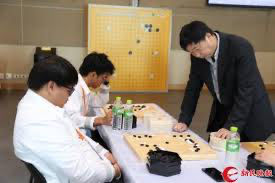
Shi Jinbo, a 3-dan Go professional from China, and the long-time national Go coach of Thailand.
His name rarely appears in headlines. Yet the leagues, the tournaments, the rating system, the youth pathways, and the million-strong Go population that Thailand proudly showcases today—none of these would look the same without him.
This is his story, grounded entirely in documented history.
I. Early Years in China: Training the Professional Way
Shi Jinbo was born in Yichang, Hubei Province.
He began learning Go at age seven, and by fourteen he had earned a place on the Hubei Provincial Go Team—a competitive, disciplined environment that produced many top Chinese players.
In the Chinese professional system:
1996 – He earned his 1-dan professional rank
1998 – Promoted to 2-dan
2001 – Reached 3-dan
Along the way, he claimed victories that reflected strong, methodical reading:
Champion of the 1-dan group in the 1998 Qisheng Tournament
Champion of the 2-dan group in the 2000 Qisheng Tournament
Though he was not a headline superstar, he possessed a reliable professional foundation—precisely the kind needed to build a Go culture in a country with limited Go infrastructure.
II. 2004: The Turning Point — An Invitation from Thailand
In 2004, a decisive moment arrived.
Thailand’s CP Group vice chairman Chai Xufeng, founder and president of the Thai Go Association, was determined to introduce Go to Thai youth and establish a nationwide structure for the sport. Thailand at that time had almost no systematic Go environment: few teachers, limited equipment, and no league.
Chai needed a coach with not only technical ability, but also patience, organizational skills, and the willingness to stay for years.
He invited Shi Jinbo to Bangkok.
Shi accepted the challenge, moved to Thailand, and began what would become one of the most significant and sustained Go development projects outside East Asia.
For the next nearly twenty years, he would serve as Thailand’s national Go coach, working at the center of the country’s Go transformation.
III. Building the Thai Go League — A Semi-Professional Model
One of the defining milestones in Thai Go development was the establishment and evolution of the Thai Go League.
Unlike sporadic amateur tournaments, the League—shaped and continuously refined during Shi Jinbo’s tenure—was designed with a professional logic:
League Structure (documented between 2014–2017):
Early editions featured 20 teams with 6 players per team
Each match used 4 boards, mirroring the structure of the Chinese Weijia League
In 2017, the League was reorganized into Division A and Division B
3 teams were relegated and promoted each year
The Thai Go Association managed collective corporate sponsorship, totaling around 30 company sponsors
Financial Model:
Total annual sponsorship: 3 million Thai baht
Of this, 1 million baht allocated specifically to appearance fees
Every game played provided board fees to players
Champion team prize: 200,000 baht
Out-of-town teams received travel reimbursement and hotel accommodation
This meant the Thai League became:
Consistent
Funded
Competitive
Structured with career-like incentives
Although players remained “amateur” in title, the league operated with the seriousness of a semi-professional competition.
In many press reports, Shi Jinbo appears as the authoritative voice explaining this system—underscoring his role in both designing and maintaining it.
IV. A Nation Learns Go: From Zero to Over One Million Players
In multiple interviews, Shi gave concrete data reflecting Go’s explosive spread:
Thai retailers (including CP Group’s stores) sold over 300,000 Go sets
Estimated Go exposure population: approximately 1.5 million people
CP Group internally had thousands of employees who could play
At least 17 universities had Go classes, courses, or clubs
These numbers have been cited across Chinese and Thai media for years.
They show not a temporary craze, but an ecosystem.
What caused this growth?
Shi emphasized three components:
1. Systematic Youth Promotion
The Thai Go Association consistently invested in grassroots youth programs, centering Go as a friendly, accessible intellectual game.
2. Media Engagement
Over time, Go became a common sight in Thai newspapers, TV reports, and university events.
A notable example:
During the World University Go Championship in Bangkok, live commentary by invited Chinese 8-dan Wang Runan drew packed audiences.
3. Corporate Cultural Integration
CP Group integrated Go into internal culture—annual Go events, competitions, and recognition for employees who played seriously.
Shi often spoke about this synergy between enterprise and sport as a unique pillar of Thai Go development.
V. Developing Future Talent: Sending Students Abroad
One of Shi’s major contributions was designing training pipelines for Thai youth.
Several Thai students were sent to:
● Beijing — Nie Weiping Go Dojo
There, they lived an intense dual schedule:
Morning: Chinese language classes at Beijing Foreign Studies University
Afternoon: Go training, 5 days a week, with long sessions
Within just two years, these students:
Progressed from C/D training groups
Rose into B and A groups
Approached Chinese amateur 5-dan strength—a threshold for top amateur competition
Many returned to Thailand and became instructors themselves, multiplying Shi’s impact.
VI. Competitive Breakthrough: Defeating Tsinghua University
A particularly symbolic achievement occurred in a university friendship tournament:
Thailand defeated Tsinghua University 9:7.
This result mattered because Tsinghua:
Has one of China’s strongest Go cultures
Has enrolled Go giants like Gu Li, Jiang Weijie, Ke Jie, Dang Yifei, among others
The match was widely reported, and journalists explicitly credited:
Thailand’s maturing league system
Nearly 20 years of grassroots promotion
Youth training pipelines
And the long-term coaching of Shi Jinbo
This was not merely a victory on the board—it was a cultural milestone for Thai Go.
VII. Philosophy: Efficiency, Coordination, and Humanity
Across interviews, Shi Jinbo repeatedly articulated a simple but powerful way of teaching Go:
1. Efficiency
“Stones should work together efficiently; teams should, too.”
2. Whole-board Thinking
He trained Thai students not to obsess over local fights but to understand direction, rhythm, and global balance.
3. Cultural Values
He described Go as a carrier of East Asian thinking—one that emphasizes harmony, balance, and patience.
4. Human Warmth
He acknowledged AI’s superior calculation but insisted that Go remains a human art:
“AI can read deeper, but people bring emotion, courage, and the beauty of imperfection.”
VIII. Legacy: A Builder, Not a Celebrity
Shi Jinbo rarely appeared in spotlights.
He did not win world titles.
He did not chase fame.
But he built something that has lasting value:
A functional national league
A multi-tiered tournament ecosystem
A youth training pipeline
A local coaching community
Millions of new Go learners
International competitiveness
And a bridge between Chinese Go culture and Thai society
From 2004 onward, he worked quietly, day after day, lesson after lesson, tournament after tournament, helping Go take root in a country where it had once barely existed.